To make furnishings, you need materials. Here, I’ll talk about how to figure the cost of materials, which determines your profits. Then, I’ll cover the kinds of materials you need to have on hand in order to craft furnishings and run your business.
In What to sell, I defined the cost of a furnishing as the cost of its materials. This kind of assumes that you only get materials by buying them. But, you get lots of them for free just from playing the game, so maybe their cost chould be zero, right?
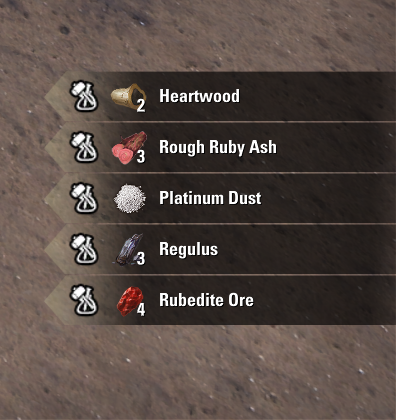
You can choose to track costs this way, by only counting materials you buy with gold as contributing to cost. But, that doesn’t account for a couple of other factors.
- Acquiring materials in game takes time, effort, and skill. Market prices reflect that, which is why hard-to-get materials cost so much.
- When you use materials for furnishings, you give up the gold you could get from selling them. I am assuming here that you can always sell all of your materials for gold, though, which isn’t guaranteed.
So, when I play the game, I assign every material a cost, which is what I could otherwise sell it for. In my last post, I used the average listing price reported on Tamriel Trade Centre as the cost. Actually, though, this isn’t the best measure. TTC listings show asking prices, but not what the items actually sell for.
Say you’re pricing Heartwood, and it has an average TTC price of 800 gold, covering all of the listings. But, it may be that people mostly buy Heartwood for around 600 gold, and those above-average, and even average, listings end up expiring. It wouldn’t be likely that you could actually sell Heartwood at 800, but instead around 600, so that would be a better cost to assign.
You can find out the real price for a material from guild history, which records the sales for all members. With data from one or two decently sized guilds, you can calculate a meaningful average sale price for most items.
Sales data from your guilds is only a small slice of sales across the many guilds in ESO, so it can be skewed. That’s why it’s good to belong to at least one large trading guild, which has enough sellers and buyers to make its data somewhat representative.
Among its many other useful features, the Master Merchant add-on gives you a report on item sales based on guild history. It even includes an average.
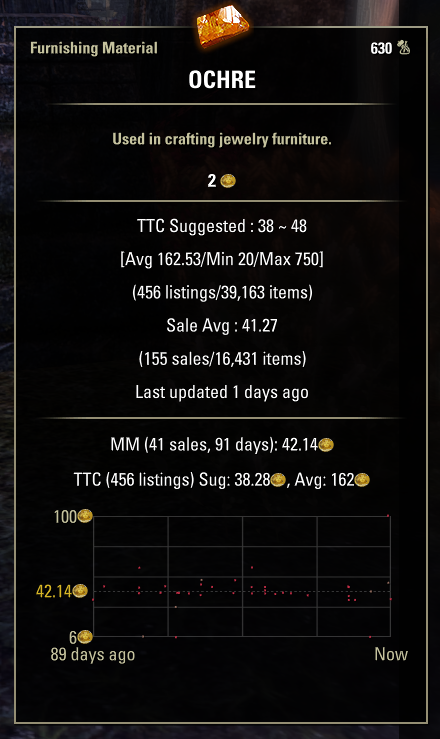
I use the Master Merchant average price for a material as the basis for my cost because it’s grounded in reality. You can use the average as is, or you can do like I do and factor in gold purchases of the material you needed to make. If you found some good deals, your costs are lower, so your profit can be higher. If your had to go high, though, your costs go up, so you may need to raise your own prices. This is a more complicated costing strategy, though, so use whatever measure you like, because what’s important is that you enjoy the game.
As with any rule, there are exceptions.
- You can buy style materials for the common weapon and armor motifs from craftsperson NPCs for a flat 15 gold apiece, so I use that instead of whatever the Master Merchant average is.
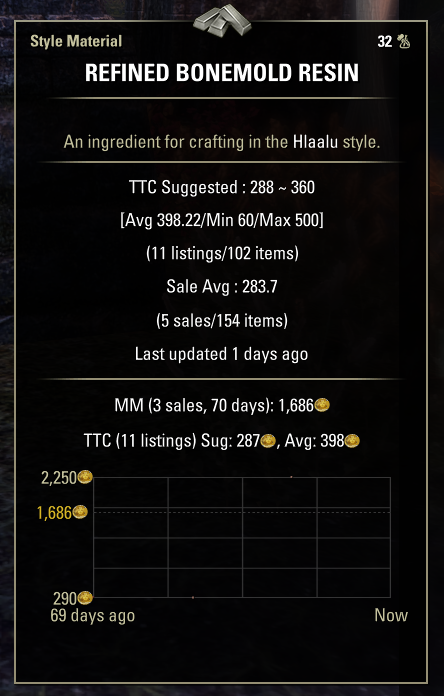
- If I see that guild sales are way out of line with the TTC average, I’ll prefer the TTC average. This can happen if there are very few sales of an item in your guilds, or if some lucky guildmate managed to sell at a very high price, throwing off the average.
Now that we covered how to cost materials, let’s look at what those are.
Central to crafting furnishings are the primary furnishing materials. They’re only used for furnishing recipes. I’ve listed them below from most important to least important to have on hand.
| Material | Recipe Type | Primary Source |
|---|---|---|
| Heartwood | Woodworking | Wood resource nodes |
| Regulus | Blacksmithing | Ore nodes |
| Mundane Rune | Enchanting | Runestone nodes |
| Alchemical Resin | Alchemy | Flower and mushroom nodes |
| Decorative Wax | Provisioning | Food storage |
| Bast | Clothing | Fiber nodes |
| Ochre | Jewelry Crafting | Seam nodes |
| Clean Pelt | Clothing | Killing creatures |
Each material is required for a particular type of furnishing recipe, but sometimes they are used for recipes in other types. Similarly, each material is primarily found through one kind of source, but can sometimes be found elsewhere. For example, some insectoid creatures drop Decorative Wax when killed.
Other common sources include:
- Hirelings, which you can get through passives on the crafting skills
- Rewards for crafting writs
- Guild banks, from generous guildmates
If you haven’t yet, be sure to activate those Hireling passives. They send you free materials every day through in-game mail, and that really helps over time. And don’t forget to enable the Plentiful Harvest craft champion perk so you get higher yields while you’re farming.
Besides the primary furnishing materials, recipes require quality materials. These are the same materials used to craft food and drinks, make glyphs, and improve weapons, armor, and jewelry. The quality material you need for a recipe matches the recipe’s quality, so you need the better, rarer quality materials to craft furnishings that are rarer and sell for more.
- Enchanting quality materials come mostly from runestone nodes and deconstructing glyphs.
- Provisioning quality materials come from different places:
- Flour comes from Flour Sacks you find around the world.
- Perfect Roe is a rare reward from fishing.
- Bervez Juice and Frost Mirriam usually come from crafting writs and Hirelings.
- The rest come primarily from deconstructing weapons, armor, and jewelry, and from refining raw materials.
- Hirelings may also send you quality materials.
Since so many quality materials come from refining and deconstruction, activate the crafting skill lines’ extraction passives to improve your chances of getting them.
Finally, you will need style materials for almost all furnishings. For the most part, these are the same materials you use to craft styled weapons and armor, although some serve other purposes. Some examples:
| Furnishing Style | Style Material | Other Purpose |
|---|---|---|
| High Elf | Adamantite | High Elf style |
| Orc | Manganese | Orc style |
| Ayleid | Palladium | Ancient Elf style |
| Deadlands | Daedra Heart | Daedric style |
| Elsweyr | Shimmering Sand | Anequina style |
| Leyawiin | Ivory Brigade Clasp | Ivory Brigade style |
| Vampiric | Vile Coagulant | alchemy ingredient |
| Redguard | Ruby (some) | jewelry trait |
You have a chance to receive a style material when you deconstruct a weapon or armor piece in that style. The sets Vesture of Darloc Brae and Call of the Undertaker, for example, use the Anequina style, so you can receive Shimmering Sand when you deconstruct an item from either set. Other sources include looting enemies and chests, rewards for dailies, or defeating world bosses.
Outside of the “basic” motifs, all of the sources for style materials are tied to their “native” zones. So, if you are looking for Shimmering Sand, you’ll need to play in Northern Elsweyr.
For hard-to-get style materials, a decent option is to buy weapons in their style with gold from a guild trader, and then deconstruct them. You only have a chance of receiving the material that way, but if the items are cheap enough, you still may end up saving gold over buying the materials directly.
I provided a lot of information here, so let me summarize by describing a straightforward strategy for you to manage your materials and their costs.
- Play ESO! You’ll get a lot of materials just from playing the game how you like to.
- Farm resources to get primary furnishings materials. When you run low on any, buy them from guild traders, but look for below-average deals to keep costs low.
- Rely on Hirelings for a steady stream of materials.
- Activate passives and perks, like extraction, to maximize your yields.

Lastly, keep your own list of materials that you use and their costs, so it’s easy to calculate your furnishing cost. Periodically update the list as material costs change, every week or so, so you know when you need to adjust your own prices.
What you may often find, like I have, is that the asking price for a furnishing on TTC is much higher than your own costs. When that happens, there’s a lot of room for you to sell at a below-market price which is still above your costs. That means a quicker sale and, most importantly, still a generous profit.