There are thousands of furnishing plans in ESO, and more are added every few months. It can be overwhelming to figure out where to start. In this post, I’ll give you some guidelines to help you choose your first set of furnishings to put up for sale.
So, when you’re considering a furnishing, how can you judge whether it’s worth selling? My golden rule is:
Sell a furnishing for more gold than selling its materials.
If the price you can sell a furnishing for is below what you can make selling its materials, then either sell the materials, or pick a different furnishing. Otherwise, you are losing gold.
For example, suppose you are considering selling Indoril Chandelier, Knotwork . Making one of these requires the following materials.
| Material | Quantity | Unit Cost | Total Cost |
|---|---|---|---|
| Alchemical Resin | 6 | 95 | 570 |
| Dwarven Oil | 6 | 20 | 120 |
| Obsidian | 10 | 15 | 150 |
| Regulus | 8 | 298 | 2384 |
For unit costs, I’m using average prices reported today on Tamriel Trade Centre for the PC-NA server. I’ll get more into how to figure out unit costs in a future post, but for now, TTC average prices are fine.
With these numbers, the cost of materials for crafting one item is 3224 gold. Therefore, you shouldn’t sell any Indoril Chandelier, Knotwork unless you can set a price higher than 3224 gold.
So, what price can you set? Well, you can pick whatever price you want, but you’ll need to know the prices your competitors in other guilds (or even your own) have set. If you pick too high a price, then shoppers will buy elsewhere. If you pick too low a price, you may get more sales, but you will earn less than you could have. And don’t forget that the total material cost determines how low you can go.
To work out the market price for any item, try either of these resources:
These services provide listings for any item you search for. A quick scan of listings can give you an idea of the market price for an item. TTC also has a price check lookup which gives you minimum, maximum, and average prices, and other useful statistics.
Both services work by having players run add-ons which scrape data from traders that the community visits. When you run the add-ons, you contribute to the data, and also get in-game price data displayed while you are shopping.
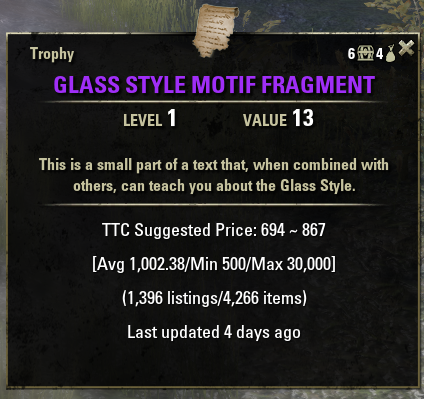
Today, TTC reports that the average price for Indoril Chandelier, Knotwork on PC-NA is 10582 gold. When you compare that with a material cost of 3224 gold, you can see that this looks like a good opportunity for profit!
I should emphasize that your goal is not to maximize how much revenue selling a furnishing produces, but to maximize the profit from the sale over selling the raw materials. This is how I play the game of selling furnishings. You could aim to maximize revenue, but if you don’t account for profit, you could ironically earn less. So: profit first, revenue second.
Profit is easy to calculate. Just subtract the cost of the item from the revenue from selling it. So, if you earn 10000 gold for selling an item, and it has a cost of 3224 gold, that’s a profit of 6776 gold.
profit = revenue - total cost
In ESO, after you sell an item, your guild takes a 7% cut. So, your revenue is actually 93% of the price that you set. This is important to keep in mind when setting a price, because if your price is only a little bit above your cost, the 7% cut may drop your revenue below the cost of materials (assuming you would sell them at healthy market prices). Continuing the example, if you set a price of 10000 gold, when it sells your revenue is 9300 gold, for a profit of 6076 gold.
The game also charges you a listing fee of 1% of your price, which also eats into your revenue. However, you’d have to pay that fee for selling the materials too, so it’s a wash. I don’t bother tracking it, since it’s just the cost of doing business.
Another useful figure is your profit margin. This tells you what percentage of your revenue was profit. To find it, divide profit by revenue. If you earn 9300 gold in revenue for an item with a profit of 6076 gold, that’s a profit margin of 65.33%, which is pretty great!
To help clarify the idea of profit margin, here are more examples.
- If you have a profit margin of 50%, it means that half the gold you took in was profit.
- A profit margin of 100% would mean pure profit! You can’t achieve this unless you decide that your materials cost is zero.
- A profit margin of 0% means you didn’t make any extra gold over selling those materials.
- A negative profit margin means your profit was negative, which means that you sold the furnishing for less than the materials cost!
profit margin = profit / revenue
My overall profit margin for 2025 turned out to be a little over 46%. So far this year I’m only at 33%, but we’ve got months to go yet!
There are a few other factors to think about when deciding whether to sell a furnishing.
- Competition. If there are hundreds or more listings for a furnishing, it can be hard to make a sale. On the other hand, if there are few or no other sellers, you may be able to corner the market … if there is demand.
- Novelty. Furnishings created from new or hard-to-acquire plans sell better than others, all else being equal.
- Quality. I usually stick with blue or purple quality furnishings, since they are almost always harder to find, and they require higher crafting skills to use. That means fewer other players are able to craft them themselves. Some green quality furnishings can also be profitable.
- Revenue. Profit is very important, but you also want to sell furnishings that have decent revenue. Don’t waste trading slots on cheap furnishings.
- Utility. Favor furnishings that housing enthusiasts will want multiple of, or which can be used in many different ways, like in cobbles. Think walls, platforms, lighting, posts and pillars, chairs, tables, and shelves.
Many of these factors are about gauging demand for a furnishing. A high-demand item sells reliably, quickly, and for a lot, which lets you sell even more. In the end, though, the only way to truly learn demand is to put some items up for sale and see what happens. Hopefully the information here helps you to pick some winners.